When the whole world has been mapped, what’s left to explore?
Original post: Another World Adventures

One of the best parts of my job is going to meet the fantastic range of operators we work with. I was particularly excited this month to get the chance to spend a week with Pangaea Explore.
Their unique offering combines adventure sailing with exploration, conservation and education, all delivered aboard ‘Sea Dragon’ their 72 ft racing yacht originally built for the Challenge Round the World race.
Pangaea invited me to join them in the Cayman Islands for a week of ‘Exploration Science’, a new trip that aims to help train a new generation of scientists and explorers, developed and delivered in collaboration with Dr Keene Haywood from the University of Miami.
Whilst much of the world has been trekked, sailed, climbed and mapped leaving little room for the traditional exploration of old, our environment continues to change at an ever-increasing pace. There is a recognition that we need experts who can understand the complex changes afoot and how these changes will impact people and ecosystems. As Keene explained to me “there is still a hugely important role for exploration – but in researching, documenting and most importantly communicating the changes we are seeing in the world”. The week aboard Sea Dragon offers a chance to learn skills in expedition planning, scientific data collection and communications as well as sailing. All vital skills for scientists, travellers and would-be explorers alike.
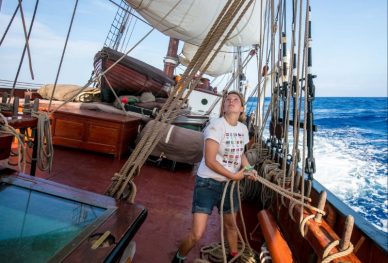
The 10 guests joining the boat were a mixture of students as well as professionals looking for an adventure holiday with a difference. Each brought with them varying levels of sailing experience and scientific knowledge but they banded together quickly as a working crew to helm the boat, handle the sails, set the course and cook up a storm in the kitchen (whatever the weather).
Unlike other sailing voyages I’ve been on there was no detailed itinerary past the first couple of days of orientation and teaching. It was up to us guest crew to plan the route and safely sail the boat across the open ocean whilst also packing in time to develop our skills in scientific data collection and communications. The fact that Sea Dragon had never ventured to the ‘Lesser Cayman Islands’ before put more gravitas on our planning. We enjoyed a full evening hunched over charts, weather forecasts and local books to plan out a schedule for the next few days.
In typical expedition-style things didn’t go entirely as planned. The weather thwarted most of our plans for land-based excursions with large swells making coming ashore very difficult. This however was just a good test of our expedition planning and gave us more time at sea to hone our sailing skills, take lectures on deck with Keene and practice our photography and video production skills.
When we weren’t sailing we were exploring the incredible underwater world of the Cayman Islands, which like much of the Caribbean has suffered coral reef degradation in the last few decades. Under the expert tuition of Keene we learnt how to undertake simple but effective reef surveys whilst diving or snorkeling. Retuning to the boat tales of turtles, rays and key indicator fish species sightings reassured us all that there is still hope for these fragile habitats.
Back on land in Grand Cayman we tried our hand at kite-mapping, essentially a form of DIY google-mapping. With a camera attached to a simple kite set to continuous-shoot mode we were able to capture huge swathes of the surrounding sea and land areas. Who says you need expensive equipment to be an exploration scientist!?
Reflecting on the week and speaking to other guests I was reassured that there is still a whole world out there to explore. But its changing faster than we can keep track off. Projects like this offer an opportunity for anyone who is interested to become better equipped to research, document and communicate the changes they see – whether you’re an explorer, scientist or just curious.
Tori