A guide to stargazing at sea
Original post: Another World Adventures
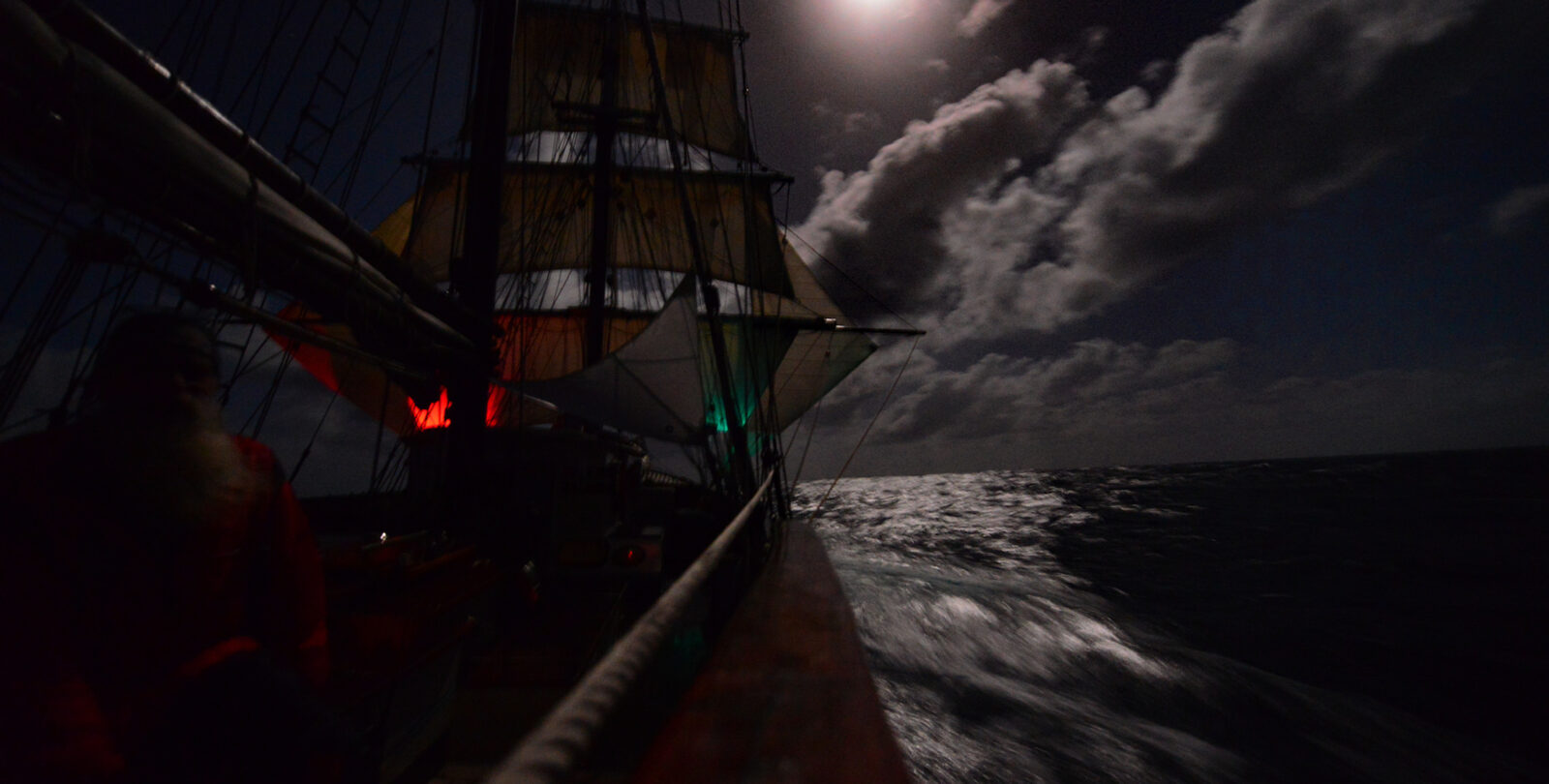
If you’ve ever spent a night at sea, chances are you’ll remember the stars. Far from the glow of city lights, the night sky opens up in breathtaking detail. At Another World Adventures, we know sailing at night is a magical experience, because of the constellations and the feeling of peace it offers. It’s also a moment of quiet self-reflection, a pause from the rhythm of life on board, where days are often filled with shared tasks, chatter and living in close quarters.
But stargazing at sea is more than just a beautiful experience – it’s also deeply rooted in the history of exploration. Long before GPS, sailors like the famous Polynesian and Viking navigators used the stars to guide their journeys across vast oceans. The night sky wasn’t just inspiring – it was essential to survival.
Whether you’re new to sailing or just curious about the constellations overhead, this guide will help you begin your journey into celestial navigation and ocean stargazing. Let’s start with the basics.
Know your hemisphere
One of the first things to understand is that the stars you see depend on where you are in the world. Your view of the night sky changes based on your hemisphere:
- In the Northern Hemisphere, you’re looking outward from our spiral arm of the Milky Way into the wider universe.
- In the Southern Hemisphere, you’re gazing toward the dense, glowing core of our galaxy.
Both offer spectacular views, but the constellations and celestial markers differ. Since it’s prime time for North Atlantic sailing journeys, in this blog we’ll focus on Northern Hemisphere skies – starting with one of the most important stars in celestial navigation: Polaris, the North Star.
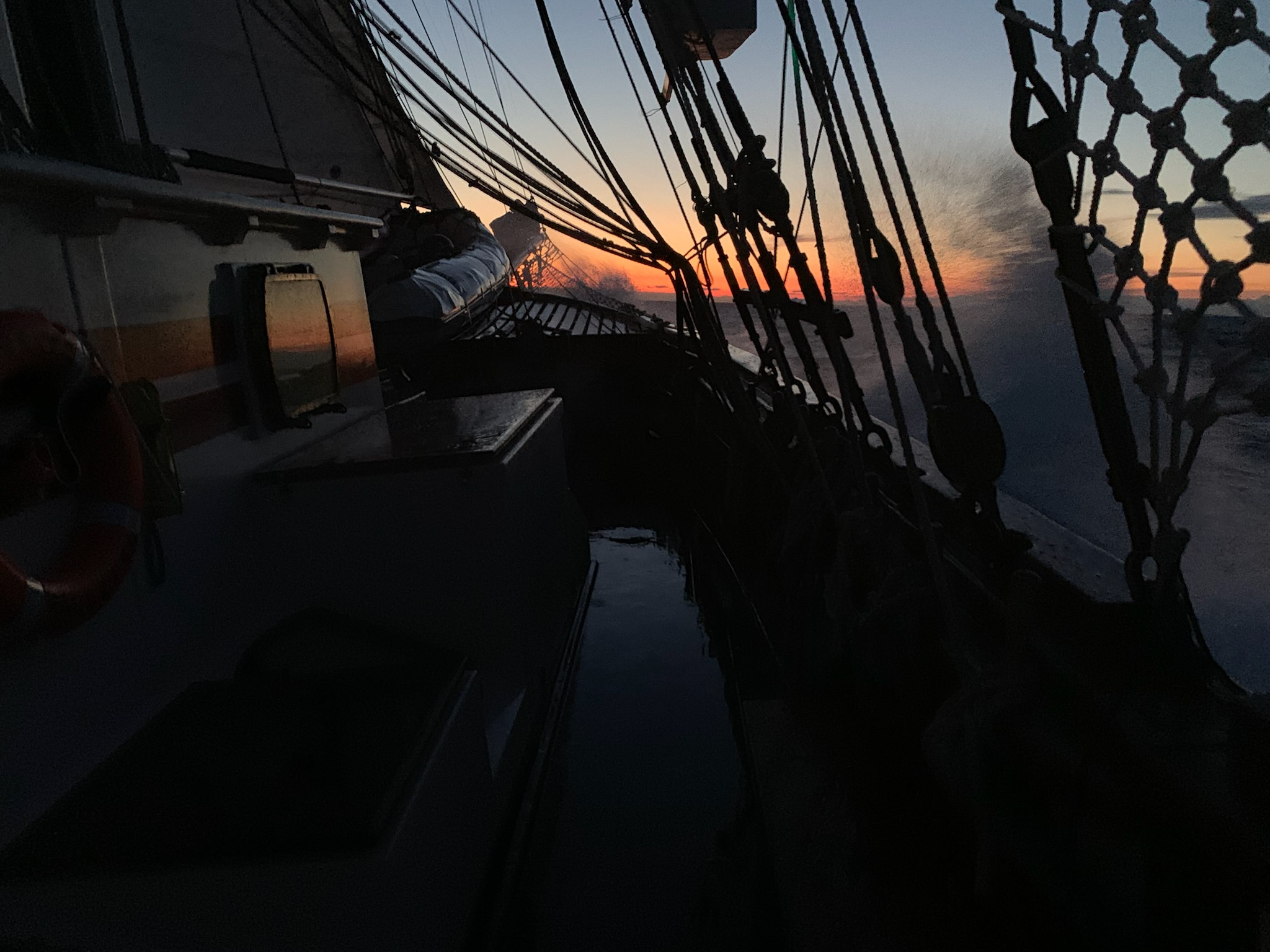
Sailing into the Sunset with Florette
How to find the north star (Polaris)
The north star sits in a fixed position above the north pole. While the other stars move around it, Polaris holds still. If you’re sailing in the Northern Hemisphere, following it will always guide you north.
But Polaris isn’t just a cosmic compass – it’s also a useful tool for navigation. The angle between Polaris and the horizon is equal to your latitude. For example, if the North Star appears 30° above the horizon, you’re at 30° north. You can measure this distance using a sextant.
To find the north star, it’s easiest to first find Ursa Major, otherwise known as The Big Dipper. Shaped like a saucepan, its two brightest stars – which would be the part of the pan you pour the liquid from – point towards the North Star.
Imagine a line extending upward from those pointer stars. About five times the distance between them, you’ll come to a single star – that’s Polaris. It’s not the brightest star in the sky, but it stands out for its solitary position at the end of Ursa Minor (Little Dipper)’s handle.
Although the Big Dipper slowly rotates anticlockwise around Polaris during the night and throughout the year, its relationship to the North Star never changes. Whether it’s upside down, tilted, or on its side, the pointer stars will always guide you to true north.
Key northern hemisphere constellations
Once you’ve located the north star, it’s easy to locate these northern hemisphere constellations:
Ursa Minor: Otherwise known as The Little Dipper, Ursa Minor is a group of seven stars which resemble a dim saucepan, with the North Star forming the end of the constellation’s ‘handle’. Easiest to spot during the darkest part of the night, it’s one of the oldest known constellations.
Cassiopeia: On the opposite side of Polaris from the Big Dipper, you’ll find Cassiopeia, a distinctive W- or M-shaped group of stars depending on its orientation. When the Big Dipper is low on the horizon or hidden, Cassiopeia can be your backup for finding the North Star – its middle star points towards Polaris.
Orion: Visible during winter months in the northern hemisphere, three bright stars in a straight line form Orion’s Belt. For navigation, Mintaka, the first star in the belt to rise and set, is particularly useful – it rises almost exactly due east and sets due west.
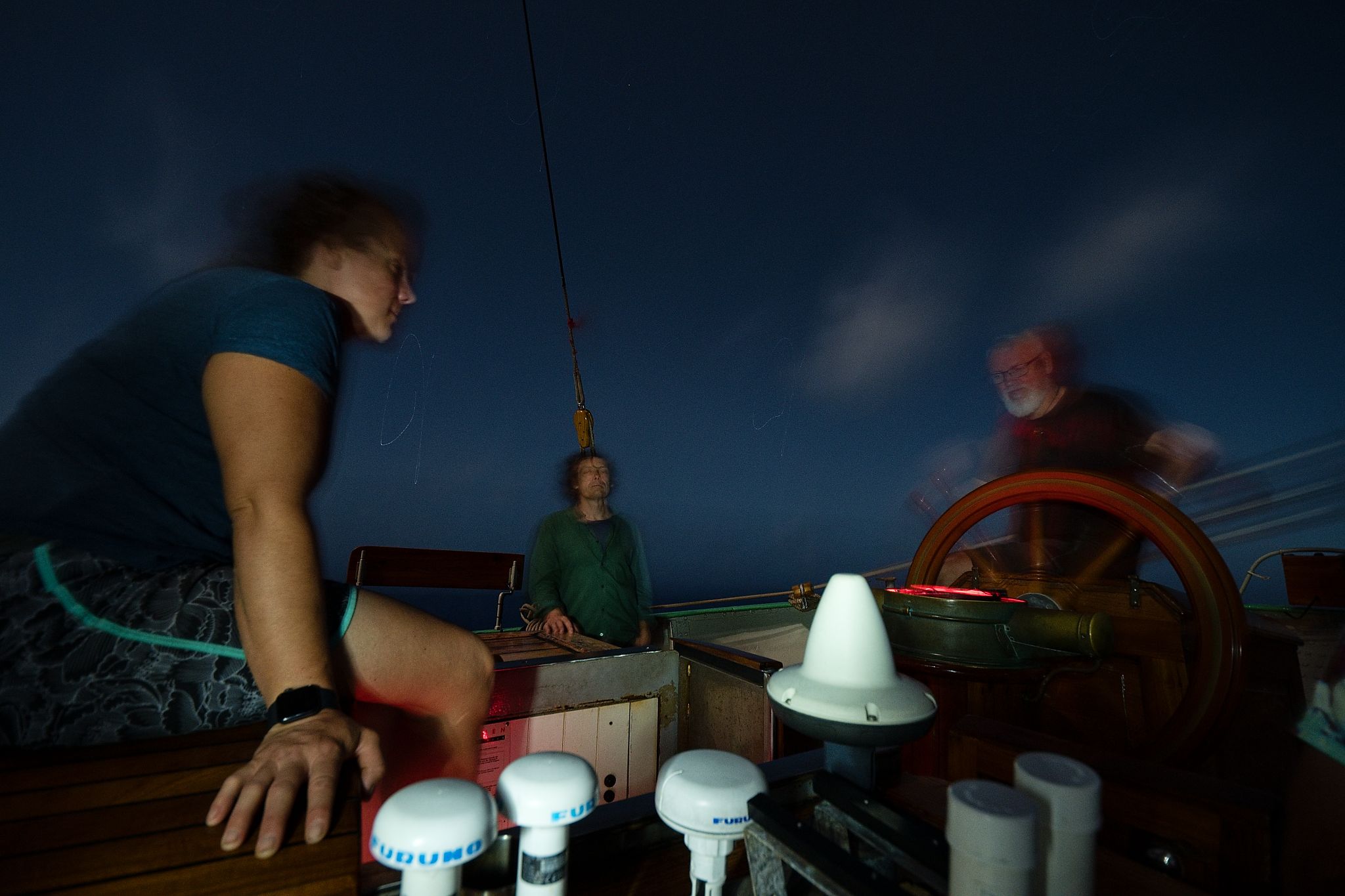
Sailing at night with Tecla
How important is celestial navigation?
In the age of GPS and digital chartplotters, celestial navigation might seem redundant. It’s no longer a staple of many modern sailing courses, where the focus has shifted to mastering electronic systems. But while it’s less commonly practiced, celestial navigation still holds real value – both as a practical backup and as a rewarding skill in its own right.
Beyond the practicalities, there’s something deeply fulfilling about using the cosmos to find your way, just as ancient mariners did for thousands of years. Learning to navigate by the stars reconnects us with the rhythm of the natural world and offers a sense of adventure and self-reliance that modern instruments can’t replicate.
Top tips for stargazing at sea
For a better chance of seeing the constellations and stars you are looking for, here are our top tips for ocean stargazing:
Time it right: The best time for stargazing depends on both your location and the time of year. Autumn and spring are often ideal because of longer, darker nights with relatively clear skies.
Chase the new moon: Aim to stargaze around the time of a new moon, when the moon is absent from the night sky. With less light pollution from the moon, stars and constellations will appear much brighter and clearer.
Stay updated on celestial events: From meteor showers to lunar eclipses and planetary alignments, there are far more special celestial events occurring than people often realise. Check astronomical calendars or apps before your trip to make the most of any rare sightings.
Use a stargazing app: Download a stargazing app like Sky Guide or SkyView Lite before you set sail. These apps can help you identify constellations in real-time, even when you’re far from shore.
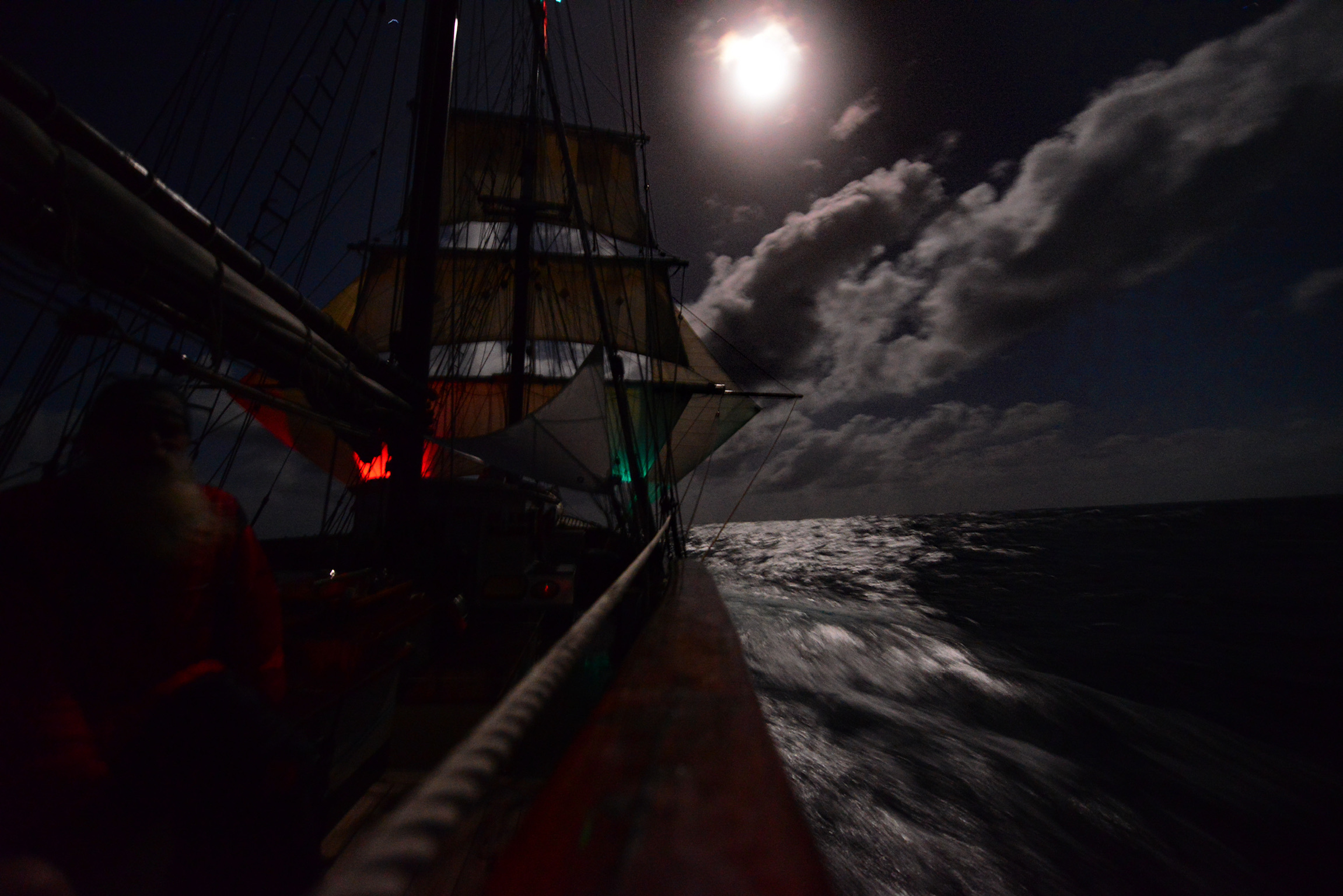
Sailing under a full moon with Florette
Ready to navigate using the stars?
If you’re dreaming of nights under the open sky, learning to sail by starlight, and reconnecting with the ancient art of celestial navigation, why not make it part of your next adventure? Whether you’d like to sail your first night passage or cross the Atlantic using celestial navigation, get in touch to discover your next ocean stargazing experience.
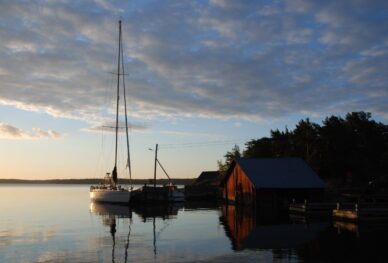
Finnish Archipelago Summer Sailing 2026
Sail among a thousand islands — Helsinki to Turku through the Finnish Archipelago

Sail Austral Islands French Polynesia (+Easter Island)
Explore wild Pacific Ocean islands on a leg of this epic voyage

Sail Around the World – Join Legs of a Circumnavigation
Sail around the world in stages — from the Pacific to Antarctica and beyond — 2026 to 2028.

Eastbound Atlantic Crossing Caribbean – Europe 2026
Sail Saint Maarten via Horta, Azores to Lagos, Portugal

Sail Antarctica Expedition 2026
Join an Antarctica voyage on a classic boat from Puerto Williams, Chile, discover the wilderness

Sail Canada to Spain Tall Ship
Cross the Atlantic by tall ship from Nova Scotia to Spain on an epic eastbound voyage.


Hi I’m Larissa, Founder of Another World Adventures. Welcome! If you’re planning an adventure you’re in the right place. Get ready to discover epic travel inspo and a collection of hand-picked trips from my trusted network of experienced adventure experts. Think unusual destinations, expeditions, slow, solo and sustainable travel and epic journeys on land and at sea! Ever got a question? Just get in touch, I answer every enquiry myself. Enjoy!